Blog series

Auto Weight-Space Programming

Atharva Naik, Emmy Liu, Varun Gangal

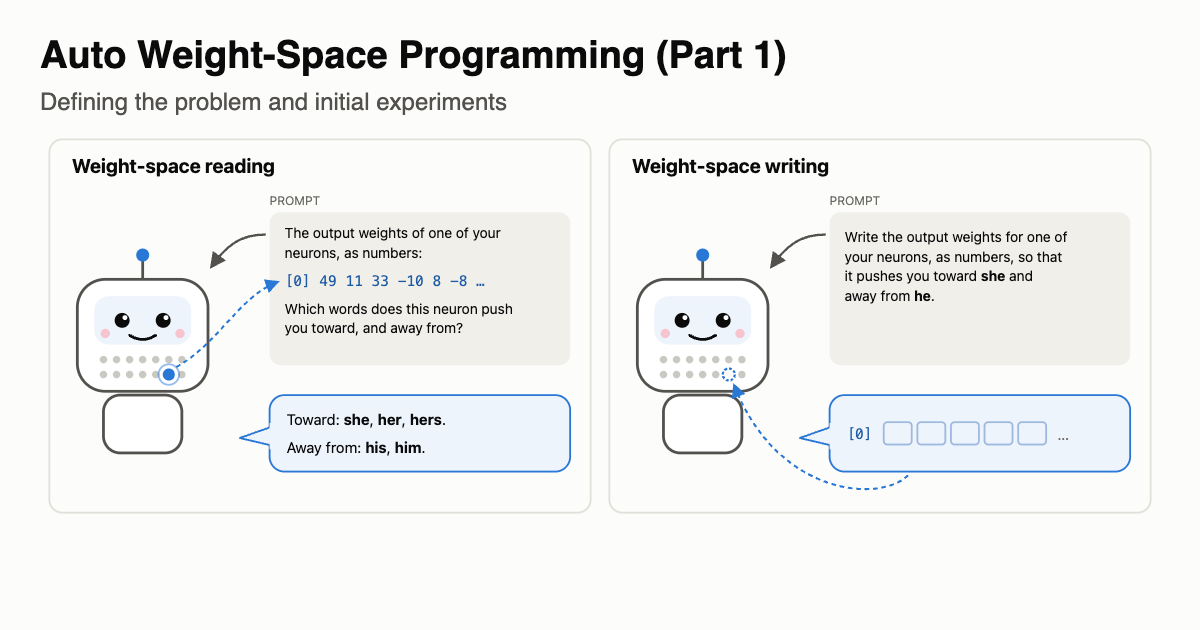
Weight-space programming means reading what a model's weights do, or writing weights that make it behave a certain way, directly from the numbers. This series asks whether a model can learn to do this to itself, which we call auto weight-space programming. Each part comes with its code, data and models.

Posts

Part 1November 13, 2026 ยท 30 min read

Defining the Problem and Initial Experiments

We formalize weight-space programming and set the goal of auto-WSP. As a toy first step, Qwen3.5-4B learns to apply the logit lens to 128-number slices of its own unseen neurons (99.8% on a four-way test, chance 25%), while naming the tokens outright, writing weights, tracing circuits and predicting behavior are next steps.
logit lens, SFT, interpretability
Defining the Problem and Initial Experiments
Part 2Coming next

Benchmarks and Evals for Auto-WSP

Collecting the weight-space programming benchmarks released so far and building a templated eval suite for reading and writing tasks, with automated grading.

benchmarks, evals

Citation

Please cite the series as one work. To point to a specific result, name the part and finding, for example "Part 1, Finding 2.3".

@misc{naik2026autowsp,
  title        = {Auto Weight-Space Programming},
  author       = {Naik, Atharva and Liu, Emmy and Gangal, Varun},
  year         = {2026},
  howpublished = {Blog series},
  url          = {https://atharva-naik.github.io/blog/awsp/}
}